Why do startups fail, according to the surveys?
The surveys do not agree, and none is official data. Official survival statistics count closures, not reasons. CB Insights' March 2026 count of 385 venture backed shutdowns has 70% running out of capital and 43% with poor product market fit. Wilbur Labs' February 2026 survey of 200 US tech founders has competition and market shifts at 45% and running out of money at 25%. A 2024 peer reviewed study of 50 founders' accounts found 70% had not sought the information their decisions needed. Founders give several reasons each, so the figures cannot be added up.
CB Insights: a count of public post mortems
CB Insights' report, dated 5 March 2026, is a count, not a survey. CB Insights sells data on private companies. It took 431 venture backed startups that publicly shut down since 2023, none with an earlier exit, and read their post mortems, founder interviews and shutdown announcements. Its analysts chose the categories.
“Ran out of capital” tops the list at 70%, but it’s almost always the final cause of death, not the root problem.
Since many startups cited multiple reasons for their failure, the chart below exceeds 100%. The analysis includes 385 companies for which failure reasons could be identified.
The rest of its chart: wrong market timing or macro conditions 29%, unsustainable unit economics 19%, ineffective strategic pivot 6%, outcompeted by rivals 6%, operational or leadership challenges 5%, technical or clinical issues 3%, fraud or legal problems 3%.
Earlier editions used other samples, and the old address now leads to the new report. The Internet Archive keeps the edition dated 6 November 2019, which read 101 post mortems, and the edition dated 3 August 2021, which read 111 since 2018. The 2021 chart is still on CB Insights' own server.
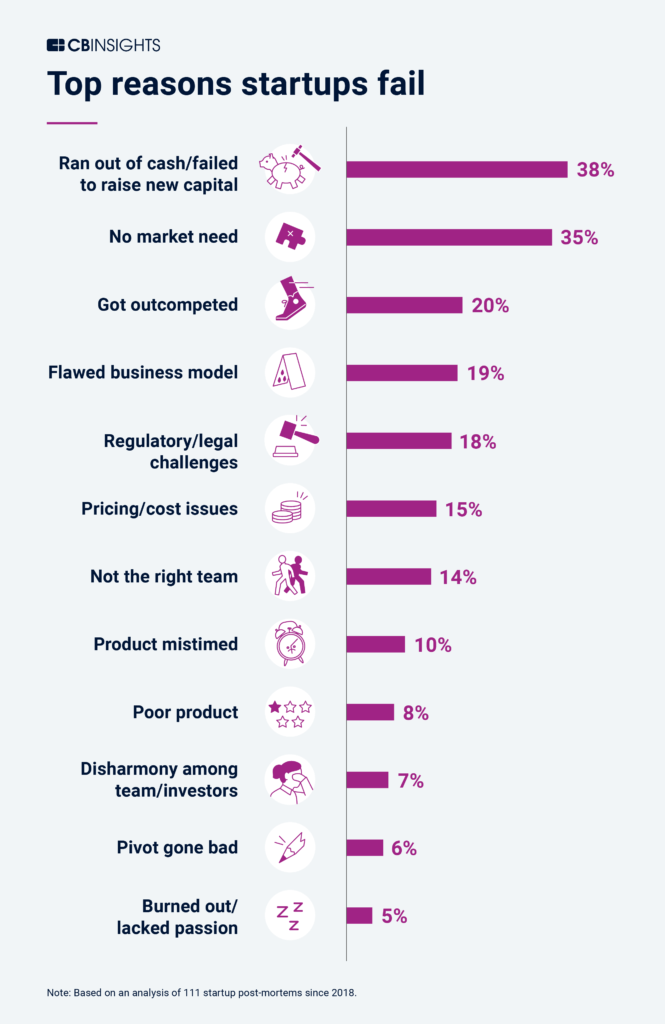
| Reason given | 2019 edition | 2021 edition | 2026 edition |
|---|---|---|---|
| Failures counted | 101 | 111 | 385 |
| Ran out of cash or capital | 29% | 38% | 70% |
| No market need, or poor product market fit | 42% | 35% | 43% |
| Outcompeted | 19% | 20% | 6% |
Money went from 29% to 70% across three editions of one report, on three different samples. In the 2026 one, the median company had raised $11M.
Wilbur Labs: a survey of 200 founders
Wilbur Labs' report, dated 28 April 2026, is a survey. Wilbur Labs is a startup studio, and Wakefield Research helped run it. 200 founders of US tech companies answered online between 3 and 12 February 2026. The stated margin of sampling error is plus or minus 6.9 percentage points.
When asked why their company failed or needed to pivot, founders most often pointed to competition and shifting market dynamics (45%), followed closely by technology or product issues (44%).
The same report has external factors at 31%, hiring missteps at 30% and running out of money at 25%, down from 38% in its 2023 survey. Asked for the main lesson of a failure, 54% said understanding product market fit better.
The question joins failing with changing direction, so 45% is not a share of failed companies. And the sample is founders, not companies that closed: 59% said they worry about their business surviving the next 12 months. The method note adds that founders' own accounts may be swayed by attribution bias, exaggeration, telescoping and recency bias.
A peer reviewed study of 50 founders' accounts
A study in Frontiers in Psychology, published 8 February 2024 by six researchers in Hungary, took 50 accounts written by chief executives of failed startups, found by web search in 2018, 47 of them about failures between 2014 and 2017. Three coders marked what each team had lacked, against an existing model of 20 competencies. So it ranks what the team did not do, not reasons such as cash.
| What the team lacked | Share of the 50 accounts |
|---|---|
| Information seeking | 70% |
| Customer service orientation | 66% |
| Technical, professional or managerial expertise | 38% |
| Analytical thinking | 36% |
| Flexibility | 36% |
The team asked the wrong questions to the wrong people. They received great reviews for the initial product, but did not ask the right people what they would pay for it, and did not generate sufficient revenue.
Information seeking means gathering data before a business decision. Customer service orientation means putting customers' needs ahead of the technology. The study counted 3.3 gaps per account. The authors name their limit: the chief executives were the only source, which can bias what is recalled and told.
Startup Genome: a benchmark, not a record of closures
Startup Genome's 2011 report on premature scaling rests on about 3,200 high growth internet startups that answered its own survey. An algorithm compared the stage each startup acted as if it had reached with the stage it had really reached, and called a mismatch premature scaling, for example spending too much on customer acquisition before product market fit. About 70% of the sample fell there.
Its headline is that 74% of high growth internet startups fail due to premature scaling. The report does not say how failure was measured, and its caveats say it had no longitudinal data yet. It also says more than 90% of startups fail, with no source.
Where the reports disagree, and why they cannot be added up
- Different companies. Venture backed shutdowns, 200 US tech founders, 50 essays, and startups that answered a benchmark survey. A share from one says nothing about another.
- Several reasons per company. One company sits under several reasons, so the shares pass 100% and are not slices of one whole.
- Different lists of reasons. Each analyst wrote the categories. The top answer is capital in one report, competition in another and information seeking in a third.
- The same essays, counted again. Fractl, a content marketing agency, says many of the 193 failed startups in its 2017 study came from CB Insights' list of post mortems. Skynova, which sells invoicing software, surveyed 492 founders in November 2022, but its method note says its reasons for failure came from CB Insights' post mortems. Reports that look independent share one pile of essays.
- Self reported. Every figure here is what a founder wrote or ticked afterwards. Wilbur Labs and the Frontiers authors both say that can bend the answer.
What no survey can show
- Cause. A post mortem is a story told afterwards by the person who ran the company. CB Insights itself calls running out of capital the final cause of death, not the root problem.
- The survivors. A count of post mortems holds only companies that closed. It cannot say how many companies with the same problem are still trading.
- The silent ones. A public account exists only where a founder wrote one or the closure was reported.
- How many fail. A different question, and the one official statistics answer. Their survival tables count how many new businesses are still trading year by year. They count closures, not reasons. Business survival rates has those figures.
What to do about it
Under different names, all four reports come back to one thing: not enough people wanted the product, and the company found out late.
- Check that someone needs it. Product market fit says how to tell, and will it sell lists what decides whether a stranger pays.
- Say who it is for and why it is different: ideal customer and positioning.
- Run one channel where those people already are. Distribution channels takes each one from its own rules, from Reddit and SEO to Google Ads.
- Hold the spending until strangers pay. Ads before anyone has paid says when a paid test is worth running.
- If nobody signs up, or people sign up and never pay, read nobody signing up and signups but no sales before you change channel.
Questions people ask
What is the number one reason startups fail?
It depends on the report. CB Insights' 2026 count of 385 venture backed shutdowns puts running out of capital first at 70%, and calls that the final cause, not the root problem. Wilbur Labs' 2026 survey of 200 founders puts competition and market shifts first at 45%. Official survival statistics record no reasons.
Is it true that 42% of startups fail because there is no market need?
That figure is from the 2019 edition of CB Insights' report, which read 101 post mortems and let each count under several reasons. It is a share of those accounts, not of all startups. The 2026 edition, on a different sample, has poor product market fit at 43%.
Do 90% of startups fail?
No report on this page measures that. Startup Genome's report says more than 90% of startups fail and gives no source for it. How many new businesses close is counted by statistical offices, and business survival rates has their figures.
Why do the reasons for startup failure add up to more than 100%?
Because one company can give several reasons. CB Insights says so beside its chart, and the Frontiers in Psychology study found 3.3 gaps per account. Each percentage is the share of companies that mentioned a reason.
Read next
- How many new businesses survive one year, five years and ten years?
- What is product market fit, and how do I know if I have it?
- Will my app make money, and when should I stop?
- Nobody is signing up to my app. What do I do?
- Which distribution channel should I use for a product I just launched?
- What do the figures really say about new businesses, apps and startups?
AskSami is a marketing and distribution expert for a founder who has launched and cannot get customers. AskSami reads what you give it, all of it optional: your GitHub repository, up to 40 pages of your live site, and the screenshots, ad exports and payment exports. From that it writes an honest read of why the product does or does not sell, and a ranked plan of up to ten ways to get customers, free methods before paid ones.
Sources
- CB Insights, The top 9 reasons startups fail, dated 5 March 2026. Read on 8 October 2026.
- Wilbur Labs, Why Startups Fail (2026): Lessons From 200 Founders, dated 28 April 2026. Read on 8 October 2026.
- Frontiers in Psychology, Why do startups fail? A core competency deficit model (Szathmári and others), published 8 February 2024. Read on 8 October 2026.
- CB Insights, in the Internet Archive's copy, The Top 20 Reasons Startups Fail, dated 6 November 2019, archived 28 May 2020. Read on 8 October 2026.
- CB Insights, in the Internet Archive's copy, The Top 12 Reasons Startups Fail, dated 3 August 2021, archived 2 December 2022. Read on 8 October 2026.
- CB Insights, Top reasons startups fail, the chart of the 2021 edition. Read on 8 October 2026.
- Startup Genome, Startup Genome Report Extra on Premature Scaling, version 1.2, copyright 2011, edited March 2012. Read on 8 October 2026.
- Fractl, Why Startups Fail: What a Decade of Postmortems Reveals. Read on 8 October 2026.
- Skynova, Startup Founders Talk Business, survey fielded November 2022. Read on 8 October 2026.
Checked on 17 October 2026. Every rule, price and figure on this page was read on the page it links to, on the day shown beside it above. They change, so open the source before you rely on one.